Tooth loss is a significant issue that can negatively affect quality of life both functionally and aesthetically. Today, one of the most successful and long-lasting ways to replace missing teeth is implant-supported prostheses. This treatment can meet the need for both fixed and removable restorations, offering comfort that feels closest to natural teeth.
What Is an Implant-Supported Prosthesis?
An implant-supported prosthesis consists of artificial teeth that are fixed or attached onto titanium implants placed in the jawbone. These prostheses can be planned as fixed or removable for individuals who are fully edentulous or have lost multiple teeth. The goal is to restore aesthetics and daily functions such as chewing and speaking in a way that feels as close to natural teeth as possible.
Types of Implant-Supported Prostheses
1. Fixed Implant-Supported Prostheses
They are screwed onto the implants or secured with special dental cements.
They cannot be removed by the patient.
In fully edentulous patients, systems such as “All-on-4” or “All-on-6” may be used.
They provide the closest feel and aesthetics to natural teeth.
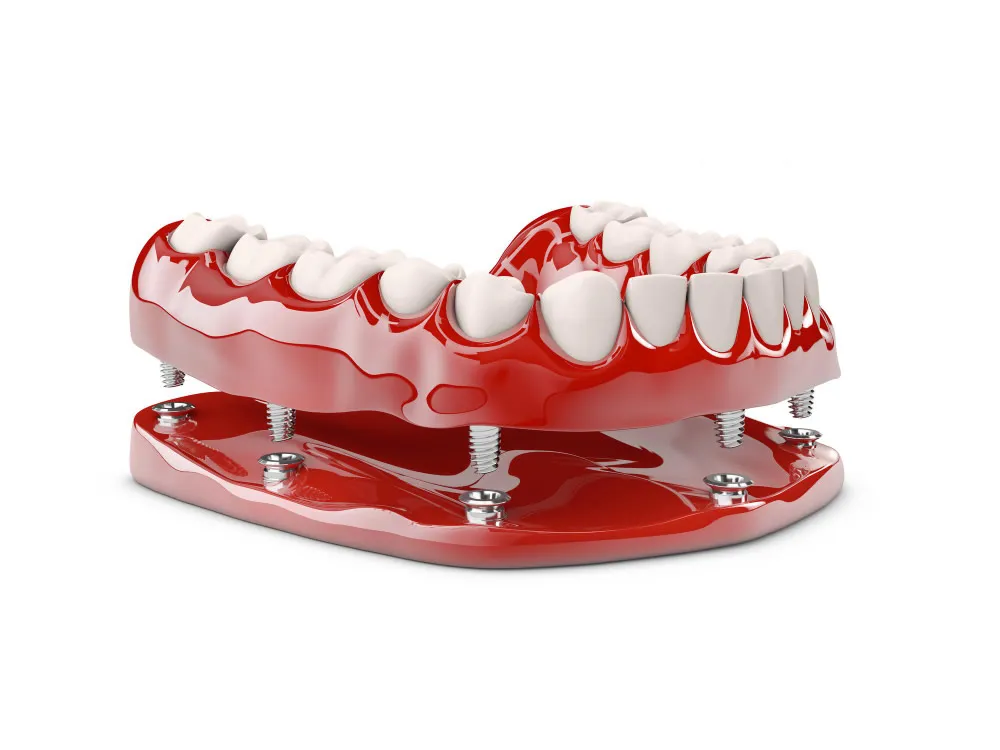
2. Removable (Snap-On) Implant-Supported Prostheses
The denture attaches to implants via retainers (locator, bar, etc.).
The patient can remove the prosthesis on their own.
It is much more stable than conventional removable dentures and does not shift.
It is often preferred to improve retention, especially in the lower jaw.
Advantages of Implant-Supported Prostheses
Stability: They do not move or slip and provide a natural-tooth feel.
Strong Chewing Ability: Allows comfortable consumption of harder foods.
Aesthetic Appearance: Offers a look that closely matches natural teeth.
Long Lifespan: With proper care, they may be used for 15–20 years or even a lifetime.
Speaking Comfort: Supports clearer speech by helping the tongue and lips position correctly.
Prevents Bone Loss: Implants stimulate the jawbone and help reduce resorption.
Who Is Suitable for Implant-Supported Prostheses?
Individuals with single or multiple missing teeth
Fully edentulous (complete) patients
Those who are uncomfortable with removable dentures
Individuals who maintain good oral hygiene
Those whose overall health is suitable for implant surgery
Patients with sufficient bone volume
Note: Pre-evaluation is important in conditions such as diabetes, osteoporosis, or smoking.
How Is an Implant-Supported Prosthesis Applied?
Examination and Planning: Bone structure is analyzed with panoramic X-ray and/or 3D tomography.
Implant Placement: The implants are surgically placed into the jawbone.
Healing Period: Typically, 2–3 months are allowed for the implants to fuse with the bone.
Impressions: Measurements are taken for the prosthesis that will fit on the integrated implants.
Prosthesis Delivery: Custom-made prostheses are placed and final aesthetic/occlusal harmony is achieved.
Comparison of Fixed vs. Removable Implant-Supported Prostheses
| Feature | Fixed Prosthesis | Removable Prosthesis |
|---|---|---|
| Aesthetics | Very high | High |
| Comfort | Closest to natural teeth | Moderate–High |
| Cleaning | May require professional support | Can be cleaned by the patient |
| Durability | Very high | High |
| Cost | Higher | More economical |